Saturday, February 1, 2014

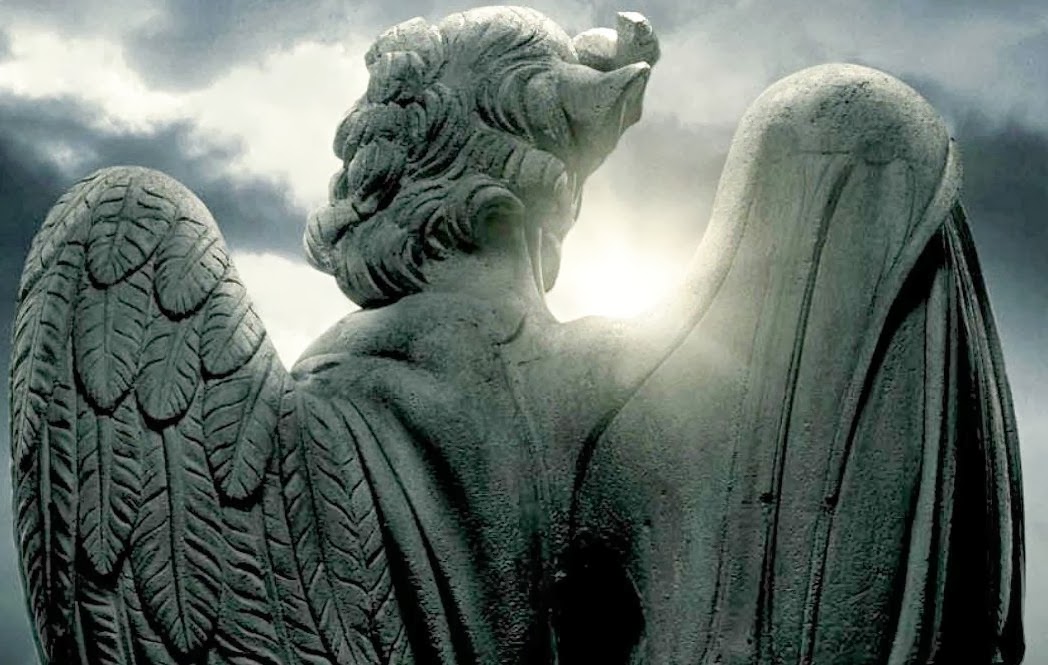
Angels Among Us

from the Angels and Demons website
Posted as week "A" of the Pagan Blog Project 2014

Originally, stories of angels came from ancient Persia and were adopted (and adapted) into Christianity via Judaism. According to the Talmud, all beings-including animals-are assigned a guardian angel.

Angels are immortal beings who live on the spiritual plane and serve as intermediaries between mankind and the Divine. In Latin the word angelus means "messenger". Hebrew scholars describe them as mal'ak elohim ("messenger of G-d"). Other translations describe them as Elohim elohim,"sons of God". Angels in early art are depicted as 'shining ones', attractive abet androgynous beings ( having neither masculine nor feminine features). The earliest renderings of angels ( in the catacomb of Priscilla, mid 3rd century) showed them in the role of messengers without the familiar halo and wings. The earliest known representation of angels with wings come from the time of Theodosius I ( 379-395).  The revered early Church writer John Chrysostom theorizing on the addition of wings to angels in liturgical art says," They manifest a nature's sublimity. That is why Gabriel is represented with wings. Not that angels have wings, but that you may know that they leave the heights and the most elevated dwelling to approach human nature. Accordingly, the wings attributed to these powers have no other meaning than to indicate the sublimity of their nature."[ The Figure of the Angel in the Early Christian Civilization, Cecilia Proverbio,2007].

A gathering of angels is known as a legion; and interestingly enough, the term is used for a group of demons as well. Just one more link between the two entities in common usage that insinuate the supernatural power ( and fear) they wield. The definition finds it's legitimacy in a vague association with the numbers of soldiers of  a major unit of the Roman army, and is most likely one foisted into the lexicon by the ancient Church to impress upon the populace the importance of both entities. The peoples of the classical nations of antiquity knew what it was like to be over-run by military assaults, and the Church often repurposed terminology to get its point across.

In Judeo-Christian and Islamic mythology the most notable of all angels are the Archangels, each of which were assigned to a specific area of Heaven: Gabriel, Raphael, Michael, Uriel, Jophiel, Zadkiel and Samael (also known as Lucifer, who would later be identified as Satan in the Bible).  In Islam, Israfil and Azrael are included in the group with Michael and Gabriel; Metatron is recognized in Jewish writing, although his existence is not considered canonical.  The actual number of Archangels varies from source to source-as do the names [http://www.beliefnet.com/Inspiration/Angels/2006/07/One-Archangel-Two-Archangels.aspx]. The only entity agreed upon by the major mainstream Christian religions is Michael, because he is specifically references as such in the Bible. [ Angels: God's Secret Agents, Rev.Dr. Billy Graham, W Pub Group, 1994]. In Kabbalistic teaching, specifically speaking of the Tree of Life, both angels and archangels are associated with each of the branches.

Until the mid 18th century, angels as messengers were common in everyday life, and the vision or sighting of one was a portent to a monumental event (note here, demons were also commonly a part of everyday life as well).  Angels were credited with everything from fortuitous luck to the heralding of plagues and curses on the command of G-d. [ Revelations 15:1,16:2-15, New King James Version (NKJV Bible), Thomas Nelson Publishing]. As the Age of Enlightenment slowly took hold and emphasized reason and logic from a non-religious standpoint, the sighting of angels became less and less common, and they were relegated to the realm of myth and folklore.

The belief that angels were once human is not canonical; it was developed by the Christian mystic Emanuel Sweedenborg during his quest to reform the Christian belief system.[http://www.swedenborg.com/emanuel-swedenborg/explore/spiritual-world/] Sweedenborg- who was also a scientist and philosopher -went through a personal  spiritual revelation in which he was divinely inspired to author The Heavenly Doctrine, where he visited with angels, demons and other spiritual entities.

Theosophist and Occultist Rudolf Steiner developed a complex listing of the angelic order as a result of his own visionary experiences. He theorized that angels were just above humans in spiritual consciousness and that angels fulfilled a multitude of of duties as they rose in through the ranks of importance," Each one has a special agenda...."[http://www.skepdic.com/steiner.html] Fellow Theosophist Geoffrey Hodson transcribed information given to him by his angel/guide into a series of books, the most notable being The Brotherhood of Angels and Men [http://www.katinkahesselink.net/other/hodson-Bill-Keidan-angelic.html]. Hodson is considered an expert on the subject of angels in certain occult circles, and his ideas are worth exploring if you are at all interested in Theosophy or  the New Thought Movement.

Modern Christian theology contents that angels have never been members of the human race. This is empirical thought across  the many variations of Christian doctrine as there is no mention of a human making the leap into the ranks of the angels in the Bible, where they are specifically described as a separate class of being who reside in Heaven as honored servants of G-d. The quaint belief that when humans die they transform into angels and 'earn their wings' is strictly romantic literary license.

With the coming of the New Age Movement, angelic visions have enjoyed an uptick. The form the angel takes has branched out from the one of the robed messenger depicted in commercial art and depends on the religious background and spiritual beliefs of the individual, as does the meaning for the visitation. In this scientifically influenced era, the sighting of an angel is commonly a part of the description of any near death experience (NDE) as related by the work of Dr. Raymond Moody [http://www.lifeafterlife.com/].

A renewal of all things angel-related is evidenced by a brief visit to the local gift shop or metaphysical goods store. They are everywhere-in books, on necklaces, key chains, T shirts and invoked in prayer and ceremonial magick. They are guardians, guides and messengers and a visual gateway to all things spiritual.


Tuesday, January 14, 2014

Ungrounded

The first few days of the New Year always feel a little weird to me: jumbled and not quite settled, like the inside of a snowglobe someone has just shaken.

Moving in the middle of last year has done a couple of things. While it did give me my own apartment-the only space that has truly been my own in six years- it has left me feeling uprooted and unable to focus. There are too many little devils in the details- or perhaps the details are the devils. I have managed to celebrate the Sabbats that have passed  (Lughnasadh, Samhain and Yule) on a  superficial level, skimming through quick solitary rituals. Frankly, I feel unfulfilled and slightly queasy. Maybe it's because I'm still adjusting to the vibe of the area ( there is incredible energy here), or because I'm still reeling from making the move from one place to another so quickly- but I am off-kilter and a little giddy, unable to settle down and concentrate on what I'm doing for very long.

With the Cold Moon- traditionally the most powerful moon of the year-only hours away, I feel the need to work on what the Theosophists term the etheric plane to clear this upThe etheric plane is the place we are most ourselves in the realm of magick. After spending so many years finding myself, I refuse to let go of who I have become, which, as I was reminded by my  friend Sandra, who's a Native American shaman..."Who you have become has always been your birthright."

I am considering a very formal ritual for this first full moon of the year. Perhaps it will bring me back to some order and discipline. Although I am basically a hedge witch, sometimes I like the ceremonial approach. ( I don't feel there is any one form of the Craft more more valid than another.) I believe that the Universe responds to whatever it takes, barring anything maleficent or generally harmful. Right now I think I need to focus with more specifically on the crafting angle of my practice since I recently reconstructed the religious aspect. The nature of the Universe it to be constantly changing, and spirituality needs to change,too, to remain relevant. I'm not talking about an about-face, just a few minor shifts in consciousness and practice. Evolution, after all, takes place at its own pace. That's the way of Nature and sometimes I have to remind myself of that little fact when I want immediate results.


Wednesday, January 8, 2014

Opening The Door Of The New Year

Janus on an ancient Roman coin
At the beginning of every year ( and yes, I am late ) I perform a ritual asking the blessing of the Roman God Janus. It is a simple rite which includes a wand, bells, and a smudge stick and shell; it can be done solitary or in a group. When done in a group, I usually have at least one other person assisting.

Janus is the Roman god of endings and beginnings. He is most often depicted with one face looking at the past and one into the future. Some artistic renderings of Janus show him as an old man looking at the past and a youth gazing into the future, reminiscent of the Father Time and Baby New Year figures used in modern New Year Eve graphics (The Romans named the month of January for him).

Janus is associated with the passages of time-beginnings and endings. He is both door-opener and door-closer.
Janus is also the protector of doorways, gates, portals, and boundaries. In ancient Rome, statutes of Janus were found on the gates of most cities (and some buildings) for this purpose. This is why I chose him when I developed this particular ritual for a group of which I was a member.

The Janus Ritual begins with the usual grounding and centering of the participants. ( Light the smudge stick and select those who will assist-if any- before hand. If there are no assistants, then the leader assumes all functions him or herself). The participants gather at the main gate or doorway, and the leader calls upon Janus to join them:

Leader: Behold, we stand at the beginning of a New Year! Janus,open the door! Here we bring our hopes and dreams for the coming seasons... [ The Leader knocks on the door frame with the wand, or the bell is rung at this time. The doorway is censed as a blessing and thanksgiving.]

Participants: Janus, open the door! 
The group processes to the next stop, where the leader repeats the words (or similar) above, adjusting them to the area. In my group ritual, we stopped at the area where we socialized around the fire, the small building we used for meeting in inclement weather (and storage), the pathway to the designated ritual space, and the fence around the property. At home, I begin at the front door, then walk through the kitchen ("...Where friends and hearts meet for food and conversation.."), the living room ("...Where lives and stories are shared...), the bedroom (" ...For whatever dreams may come...") and the bath ("...Where we are physically and spiritually cleansed of the world..."). You may choose other places and words that suit your personal needs and situation.

I find that this simple ritual is a good way to kick off the New Year for me.
[Additional historical information can be found at: http://en.wikipedia.org/wiki/Janus]

Friday, December 27, 2013

Regeneration

Originally posted to the Pagan Blog Project 2013 as Week R
**Technical difficulties posting.Sorry!**

The longer nights give me more time to read and ponder; to examine my life and consider how I will make the changes that need to be made. The Irish call this time of contemplation the Place of Deep Indwelling. Like seeds placed in the rich, dark soil of Autumn which incubate, sending their roots deep into the earth and their leaves sun ward, I work at regeneration and revival of my spiritual life.

Building a personal spiritual practice takes time: time to read and digest. Time to study and put into practice. To see how well things work- and what doesn't work.

I only keep what resonates within me. There are many things which I find interesting, but I know are not for me. Some things which were beneficial early in my spiritual formation are discarded when they no longer make sense or no longer work. When I first came to Paganism, I had no teacher other than the natural order. I developed rituals and spells on my own based on what I felt. Later, when I was introduced to a formal occult tradition, there were many rules and guidelines to learn and follow as a member of a coven. I did so for a year and a day, and several years more as I achieved the tradition's degrees. I studied esoteric traditions along side the courses that lead to my ordination into a mainstream Christian denomination. I saw nothing that contradicted one or the other, until I took a sabbatical and began discernment...and then I began 'cleaning house', sweeping away those things that no longer served the greater good or grew who I was becoming.

Rules are needed to keep chaos in check,but too many rules create their own disorder and confusion. I kept the basics that made sense: the belief in the Divine and the Source of the Universe; maintaining a daily devotional practice; practicing the tried and true methods of spellworking and magick. The rest I allowed to gradually fall away: rigid belief in specific orders of worship; preconceived notions of Divine expectations; rules I was told needed to be followed to the letter, lest dire consequences result. The less I participated in groups, the less my practice was influenced by others.

I love pomp and liturgy, but they have their place. I began this path listening to the voice of the Divine through Nature, without labels, degrees, or roles to execute. In the past year I have returned to the simple practice of allowing the gods to guide my worship and magick. The result has been a relationship with the Divine that is more conversational than just me kneeling in the temple in supplication. I can cast my solitary circle whenever it feels right to do so-with or without the tools and assorted accouterments. For me, this has resulted in a less pretentious, more genuine-feeling form of the Craft.

I know in my heart and with my head that I will never return to the formal mainstream religion I left. Not that it was wrong-just that I doesn't fit in the plan for my own spiritual integration and growth. The same can be said for the esoteric traditions I have studied: I am keeping what feels right and applies to where I am currently in my understanding of the Craft. I may never celebrate in those circles again, but I will give credence to their contribution to my solitary practice.

Like the salamander or the Phoenix that continuously regenerates, I rise again, content that my spirit is reborn anew.


Thursday, December 26, 2013

Questions... and Answers

image via Bing
Originally posted for the Q week of the Pagan Blog Project 2013
How do you respond to questions by others about your Pagan spiritual practice?  Does your stomach suddenly knot and your mind race race for a reply? Are you defensive and ready to pounce? Do you cast a weary eye and blow them off? Or do you launch into a lecture about the Craft?

None of the above responses seems correct to me. To the nonchalant passerby who's seen my Celtic pentagram pendant and remarked, " Nice Star of David", in the past I have often responded, with a smile or a simple "Thank you"...and felt a wee bit dishonest later. Now I smile and quietly say, " It's actually a pentagram. " Most people will smile or shrug in return; if they raise an eyebrow, I will add," It's an esoteric symbol of the elements and spirit". Or if they're feeling a little embarrassed about their mistake they will answer," Oh...".  No huge theological confrontations, no debates on The True Religion, no accusations of Devil-worshipping. The fact  is, the majority of of the people you pass on the street don't care what you're wearing, or what your tattoo symbolizes. Most of the time they're just trying to make small talk because most of us are uncomfortable with silence and feel we have to say something-anything-to fill the void with sound.

Remember, you choose how to respond and you are the master of your emotions. "Easier said than done!", you say...Well, yes...and that's why we all need to develop a personal version of The Elevator Speech [http://en.wikipedia.org/wiki/Elevator_pitch]. Developed as a marking tool to make a quick, memorable impression of a business or brand, The Elevator Speech is now being touted by human resources experts as a personal mission statement for job seekers. Psychologists, however, have seen the value of making it a part of everyday socialization skills, e.g., as a introduction. In the religious community, it has become a personal mission statement of sorts, a way of empirically describing your spiritual path without being confrontational.

The Elevator Speech gets it's name from the length of time it usually takes for an elevator to travel from the ground floor of a building to the top floor-typically 30 seconds to 2 minutes. The typical Elevator Speech contains three key points: market (who you're talking to), contribution (what you do), and distinction (how what you do has value). To put this into the perspective you will need to develop an Elevator Speech to describe your spiritual path, you must determine those points you want a non-believer to know without sounding as if you are proselytizing: e.g.," It's a pentagram, and is worn by many Earth-centered spiritual traditions as a symbol of their faith because it represents the four elements of Nature and Spirit."

There...now wasn't that simple and to the point? No zealotry involved! No snappy retort or snarky attitude-just the facts, because that's all they need to know for now. You are now, of course, free to elaborate should this individual and you later go for coffee after you disembark from your theoretical elevator. The Elevator Speech naturally creates the opportunity for further discussion should that follow.

Your Elevator Speech has allowed you to let the other person know a little about you without making them feel like you're trying to jam your faith down their throat. If you can't believe this  brief exchange can be effective, consider this: With these few words the God/dess has allowed each of you to retain your dignity through the process. You have been given the opportunity to educate another while expressing the essence of your faith in a non-offensive manner. Your language, approach and what you have chosen to highlight have delivered a core message without out imparting too much information and putting someone off, and you have done no harm in the process. The article cited here from Pathos was written by a Unitarian Universalist with UUs in mind, but can easily be adapted by Pagans and other non-mainstream spiritual traditions:http://www.patheos.com/blogs/carlgregg/2013/09/unitarian-universalism-in-30-seconds-developing-your-uu-elevator-speech/ It is worth reading because it has information that can assist you in formulating a personal statement of your beliefs if you don't have one already, and help in writing that Elevator Speech for yourself.

You may find yourself needing to write several versions of The Elevator Speech for various occasions, like if a co-worker asks you what that naked fat lady you're wearing around your neck represents, or if your mother inquires about your Penkhaduce from the Grey School of Wizardry. Whatever you do, let your words flow naturally. I advise avoiding the inclusion of tradition specific jargon or other language that will only confuse those from outside your religion. A smile in return in a great opener because it lowers the other person's defenses, promotes friendliness, and confidence ...then you can launch into your Elevator Speech.The more you practice it, the more confident you will become. [http://www.quintcareers.com/elevator_speech_dos-donts.html]

But then, again...What if the other person sees your pentagram and goes off on a religious rant about Satan, or the "evils of the occult"? As unnerving as this type of attack may be, your Elevator Speech can be used as a grounding point for you and a positive springboard for engaging this individual in a non-confrontational manner. Take a breath before you reply, center yourself and say something like, " The pentagram has been used as an esoteric symbol in many of the world's religions including Christianity and Islam. As a Pagan/Wiccan/Heathen, my faith tradition does not believe in the existence of Satan/the Devil. Our tradition is centered around the recognition of the wonders and beauty of the Natural World." And then, Gentle Friend...walk away. I mean it...you do not owe this individual any further explanation. You have stated your belief and defended your faith and nothing more be done lest you wish to engage in a full blown theological battle. These types of individuals want to goad you into a screaming match to show everyone else around them how uncouth, rude and character-flawed Pagans are and so they can secretly gloat over your counter attack of their God while appearing to be a victim. Don't fall for it, it's a psychological trap. Make your statement and move out of their space as quickly as you can. ( And in doing so, please try to be tolerant and understand that some folks are just well meaning and think they're doing no harm. They are only doing what their religion tells them to do in the case of someone 'unsaved'. Many fundamentalist denominations place blame on an individual who fails to offer salvation in the name of their God to others; you have the right to refuse-politely. Thank them for their concern about your spiritual well-being, and if necessary gently remind them that Paul and Barnabas shoot the dust off the feet of the city that rejected them...and suggest they do the same. That usually ends any further attempts at conversion with no argument).

So...The next time you're asked to describe your religious beliefs, how will you answer the question?


Wednesday, December 25, 2013

And So This Is Christmas...

And so this is Christmas-

and what have you done?
Another year over
A new one just begun.
Happy Christmas (War Is Over),John Lennon and Yoko Ono


One of the things I've recently observed within our Pagan community is how many of us still celebrate the Christmas holiday in some fashion- be it to mollify our non-Pagan families and friends- or just out of habit. This morning I found myself replying to Christmas greetings from a wide variety of friends online-many whom are Pagan. I also keep Christmas in my own way- mainly as a small way of remembering my grandparents and others who have crossed the Veil and because of the memories of Christmases Past. In my own solitary spiritual practice, I celebrate Yuletide, which incorporates the Winter Solstice and the 12 Days of Christmas, with a bit of Saturnalia and the weeks of waiting known as Advent thrown in for good measure.

I have stood in the cold winter evening to celebrate The Longest Night with friends,walked thorough a wonderland of snow to Christmas Eve Service, shared a feast with Pagan friends,and sat at my kitchen table reading Christmas stories, then performed a ritual to celebrate the birth of the Divine Child...and it has all felt right and genuine to me. There is no set criteria of how to celebrate Christmas in current society; it's a secular holiday of Santa and sugarplums, with no strict religious mandates for many. Personally, I don't have a problem crediting the 25th of December with being the birth of Jesus because my worldview is that the day/time/season is more than that. My psyche gravitates more to it being Winter and a time of nesting and simply being. Something within me wants to celebrate these last precious few weeks as a time apart by being festive. So I haul out the tree, cover it with ornaments that are the keepers of memories,deck the halls and celebrate the season by cooking foods I seldom or never eat at other times of the year, giving my friends tokens of appreciation for our friendship, and honoring the people who have contributed to my life in large ways and small ( those who bring a smile or a laugh, and those who have hurt me so deeply that years later, the memory still  makes me cry). As much as I detest the commercialism, I love the excitement and expectation, the glitter and momentary excess of Christmas. I love the still moments when I look up at the stars and marvel at the vastness of the sky, and sitting in a room lit only by the lights on my tree. I love the feeling of sacred space and holiness of candlelight, the peel of the church organ playing O Come All Ye Faithful, and the simplicity of a single guitar playing Silent Night.

But it is not Christmas for me until I have heard John Denver sing Christmas for Cowboys, or fretted over baking fruitcakes and cookies and taken in their wonderful smells. Christmas is not made sacred until I have made and eaten a luxurious antipasto on the green Jadeite or yellow Fiestaware platter my grandfather used to build his amazing creations filled with fine Italian meats and cheeses and topped with a crown of tuna in oil and sliced red pickled eggs ( It's been 26 years since he died,when I took over the tradition first for the family, and now, just for me). It is not special until I place Aunt Laura's favorite white plastic reindeer on a branch ( always the first ornament on the tree) or my favorite Kermit the Frog from the 70's just beneath the angel that belonged to my grandparents. It is not all waxing warm, fuzzy nostalgia, it is also recalling the drinking to inebriation  and resulting fights, and the fact that some of the toys I thought Santa had brought me were returned to the store the day after neighbors, friends and family visited because Mom and Pop wanted to save face and didn't want anyone to know how poor we really were. My anger and resentment from childhood has faded since then, replaced with sadness and aching for their actions. I don't pretend to understand all of their motivation, but so many years later, I kind of get it.

Christmas these days is a place I deeply dwell in my soul. Perhaps it's that way for you, too. Old habits are difficult to break, which is exactly why so much of what we now recognize as Pagan practice was adapted by the Christian Church when the new religion was created with the intention of eradicating the old ways. I'm not getting into any self-righteous finger-pointing, just stating fact. For thousands of years, there has always been the birth of a Divine Child celebrated during this time. It doesn't matter if his name was Jesus or Mithra or Sol Invictius. What matters is the hope of being born and reborn, the yearning for goodness and the possibility of benefit to all living we can bring. This is reflected in the words of a poem I love (later a UU hymn) written by Robert Lehman in 1913:

Within the shining of a star we catch a glimpse of who we are;
in every infant born we see the hope of our nativity.
The miracle of each new birth can shake and save the stony earth;
triumphantly the newborn’s cry
strikes echoes from the waiting sky.
Be well. Do good as much as you can in the world. Laugh alone and with friends and family, drink moderately and be merry, break out the glitter and shiny stuff, hang the greens-especially the mistletoe-and sing out whenever you feel like it. Soon, today will be the day after yesterday, and will never be again.

Monday, December 9, 2013

Fruitcake and Other Delights

Dark. Rich. Sumptuous. Nothing says Festivus to me more than a fruitcake- a real fruitcake, not one of those pathetic things from the grocery store. Make ahead, pour on the brandy to cure it, and wait...definitely worth it. Serve it in little chunks with strong coffee. Food of the Gods. Enjoy!
fruitcake recipe

"...Visions of sugarplums danced in their heads..." Have you ever wondered exactly what a sugarplum actually  was? Maybe a plum rolled in sugar? Sugarplum is a term originating from the 1600s that described any decorated dried fruit-dates, apricots, prunes, figs, apples- a confection/candy made from a ground mixture of fruits, nuts and spice usually rolled in sugar to coat it, then sliced into pieces. They are also known as sweetmeats and were considered a luxury to be indulged in only on special occasions. In modern terms, sugarplums are a type of thick confit-diced fruit cooked in syrup or water until nearly dry, dropped by spoonfuls or rolled into logs and coated with chopped nuts, powdered sugar, or colored sugar. They can also be wrapped in thin dough and baked as a type of cookie or tart. A whole date stuffed with slivered almonds is a simple way to make sugarplums.

Mincemeat was a mystery to me until I actually made it myself- and it's delicious! The original recipe contained ground (mince-ed) beef, venison or rabbit, with beef suet, ground up fruit, nuts and spices, combined with whiskey, brandy or rum. Most mincemeat recipes nowadays omit the meats and/or suet and use vegetable shortening. It is available commercially- but it's pricey, and I think it tastes a bit 'off' or sour as it comes from the jar, so I 'doctor' it with a bit of brown sugar and brandy. The mixture can be used in pies ( I have a terrific recipe for pumpkin custard pie that calls for a layer of mincemeat under the pumpkin filling; the top of the pie is either left plain or covered with chopped nuts and crumb topping like that used on French Apple Pie. Usually mincemeat pie is baked with a double or lattice crust, but I have also made it in tartlets, folded tarts. A particularly wonderful way to use mincemeat is to spoon it between layers of buttered phyllo; it just melts in your mouth! I have also included a cup of mincemeat in fruitcake: it makes the cake extra spicy and moist.

If you'd like to try your hand at making mincemeat the traditional way, I've provided a link to a recipe by Alton Brown. There are numerous recipes for making mincemeat online, but this particular one is close to the one I've used before.

http://www.foodnetwork.com/recipes/alton-brown/mincemeat-pie-recipe2/index.html#!