
Traditionally the first day of the First Harvest is known on the ancient Celtic calendar as Lughnasadh. The Feast
of Lugh, or more accurately, the feast in remembrance of his foster
mother Tailtu, who died from exhaustion after clearing a field after she
and her people were defeated by the Tuatha De Dannan in Ireland. Her
death coincided with the yearly grain/cereal harvest. Lugh made a solemn
vow that her selfless sacrifice would never be forgotten. At least for
me, the real meaning of Lughnasadh is giving thanks for personal
harvests, the sacrifices of ourselves and others that made that bounty
possible. We sing and dance, light bonfires and share seasonal food as a
way to acknowledge the promise of the continuation of life. In another
age it was one of the times popular for trial handfastings for a year
and a day. Lughnasadh marks the beginning of the harvest cycle in the
Northern Hemisphere, and is the first of the harvest-themed sabbats
celebrated by witches and neo-Pagans. It is also one of the
cross-quarter days of the Wheel of the Year, days positioned half way
between the Solstices and Equinoxes. ( It is mid-point between the
Summer Solstice, or Litha, and the Autumnal Equinox, or Mabon.)
Lugh himself was a Sun god in the Celtic pantheon, often referred to as Lugh of the Long Spear (remember
that Ancient Celtic stories are a part of an oral tradition, so that
the myths and attributes of the main characters are often tailored to
the specific area and audience to which the story is being told).
Olympic-type games are featured at celebrations honoring Lugh-as well as
the brewing of beer, mead and malt products. The stories of Lugh have
changed and morphed over the years, and by the 17th century we see a
secularized version of the myth featuring John Barley Corn as the
personification of the grain deity. Scottish Poet Robert Burns
immortalized him in 1782. The character of John Barley Corn has been
remembered in countless songs (and many versions of those songs) until
modern times. In the troubadour tradition, Steve Winwood, then the lead
singer of the rock band Traffic, recounts the life and death of
the hero in the song "John Barley Corn Must Die"(1970), one of the most
familiar known versions of the story.
Many of the earlier
versions have the protagonist being murdered by three kings of
unspecified identity; later ones identify the assailants as mere mortal
men reduced to the foul deed by drink.
The main concept of the story
in all versions remains that the mysterious John Barley Corn was
willingly killed, shedding his blood for the good of all in the manner
of a dying god, and then being triumphantly resurrected.
In some
places a kinder, gentler form of the corn/grain deity exists in the Corn
Dolly. Variations of the spirit of the crop lived in the Corn Mother,
or goddess of European origin. Effigies of her were woven out of straw
and hung in the home as a talisman. (The most common version seen in the
US today is the corn husk doll in Autumn.) Other times stylized
fetishes were made out of shocks of corn still standing in the fields
and often plowed under as an offering to the land.
Much later the
pagan festivals were superseded by a Christian feast day in both the
Roman and Orthodox Churches known as Lammas ("Loaf Mass", from the Saxon
hlaf mas).
On August 1st, tradition held that a loaf of bread freshly baked from
the recently harvested crop was brought to the Church for blessing, then
bits of the bread were distributed to the four corners of the keeping
place where the grain was stored to protect it. Another custom says the
bread must be given as an offering to the Church as an annual tribute to
the Pope in Rome (" Pope Pence"). As with the
ancient pagan oral traditions, many versions of customs related to Lammas exists
; some
are still in existence today, but most are long forgotten. Beginning in
August and lasting until late November, countless harvest festivals
abound in numerous forms, the prominent activity being a display of
baked goods, apple cider pressing,and crafts.
At home my personal altar is laid
with
a few pieces of wheat, an ear of corn and a dish of barley. Late
summer flowers are included. The Great Offering is made with corn cakes
and mead or apple cider. I have also used barley water sweetened with
honey. I use corresponding colors of yellow, red, orange and greens
.
My invocations are addressed to corn goddesses such as Demeter and
Ceres, and include Sun gods such as Lugh of the Long Arm. I especially love to include the
Song of Lughnasadh by Caitlin Matthews from the
Celtic Devotional: Daily Prayer and Blessings. One year we
built a ritual around the legend of John Barley Corn, using stanzas of
the song to help tell the story of sacrifice and renewal of the land. I
often make simple corn husk dolls or straw braids tied with red ribbons
to hang around the house or give to friends.
Something else I like to do is bread bread to give away. This
is my favorite wheat bread recipe. It is one I learned about 30 years
ago and still stands the test of time. Delicious right out of the oven
with fresh butter ( I recommend Kerry Gold if you don't have anything
local ):
2
Tbs. dry yeast
¾ C . warm water
1- 12 oz can evaporated milk
¾ tsp salt
½ C. honey
1 ½ C. boiling water
7-8 C. whole wheat flour
1 C. unbleached white flour
> Put yeast in warm water to activate 10 minutes
>In large mixing bowl, whisk together milk, salt, honey, boiling water; mix
in activated yeast
>Whisk in one cup at a time whole wheat flour. Knead in 1 ½ cups flour until
dough is no longer sticky. On a well-floured surface, knead in more flour until
smooth and elastic. Let rest 10 minutes. While allowing dough to rest butter
two pans for bread.
>Cut dough in half, work half at a time. Knead five minutes more and cut
into three 18 inches strips to braid bread. Braid dough and shape into ring.
> Place each braided ring into buttered pan or cookie sheet and let rise 30
minutes.
> Bake in moderate oven until loaf sounds hollow, or 2-3 hours in solar
cooker.
How ever you choose to celebrate Lughnasadh, be bountifully and joyously blessed!
[ Lyrics and audio version of John Barley Corn is Dead can be found here:
http://www.azlyrics.com/lyrics/stevewinwood/johnbarleycornmustdie.html]

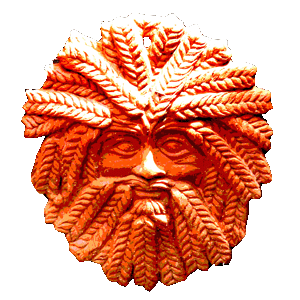 I have said before in this blog that I am not a Summer person; heat and humidity makes it my least favorite season. But I will admit to a special affinity for High Summer at the point of Lughnasadh when the corn has tasseled and stands waiting to be harvested. There is something that speaks to the spark of life at this time of year. There is an accomplishment that is both glorious and bittersweet that reaches back through the ages and loves us into life.


