Friday, April 25, 2014

Initiation-A Fire In The Head

Originally posted to the Pagan Blog Project 2014, Week I.

In religious art, saints are often shown with a flame positioned above the head. There are two meanings to this; the first is that the individual was among those present at the first (Christian) Pentecost and received the Holy Spirit (Acts 2:1-31,New Oxford Annotated Bible), the second is that the individual had a deeply spiritual connection to a Divine source of inspiration. During the Middle Ages of European history, the common human on the street lacked the ability to read and write, so the meaning of ideas was taught symbolically through paintings and street theater. It was not unusual for someone who'd had an epiphany or sacred encounter to be portrayed with a flame above their head-literally, "a fire in the head."  As far as I can trace it, the term originated in the ' Song of the Wandering Aengus',in which William Butler Yeats refers to the visionary experience as "...a fire in the head." It is an odd phrase which I don't fully believe can be understood unless you've experienced it first hand. Many of us have had this experience just before or during our initiation into the occult mysteries (the private one, between just you and the Immanent Divine).

So here is the story of my personal initiation. I have back-linked it to an earlier post that I wrote because I don't believe I can write it any better now than I did then. Sometimes you just have to allow a thing to stand for the record.


http://amethjera.blogspot.com/2011/02/fire-in-head.html

Tuesday, April 22, 2014

Hare Comes Peter Cottontail...

Posted to the Pagan Blog Project 2014, Week H

Hare,hare...ahem...Spring is in the air, Easter eggs are on the lawn,and there are leapin' lepus  are everywhere! Unlike their close rabbit relatives, hares bare their young in a nest of flattened grass (not in a burrow underground), and they are fully furred with eyes wide open and are instantly independent ( those equally adorable baby bunnies are born with their eyes closed and are essentially naked)...which means the hare literally hits the ground running.

Normally quiet, the male hare goes into a hormonal frenzy during mating season. The image of two hares standing on hind quarters and "boxing" aren't two males competing over a female, but is more likely a female striking a male with her front paws to avoid mating.

In tribal mythologies-African and Native American-the hare is a trickster. A character who lives unconventionally by his wits, Brother Rabbit (Br'er is a contraction, likely an honorary title given to him by indigenous people to recognize kinship) wrecks havoc on his enemies in outrageous situations.  It is believed that the Br'er Rabbit Stories popular in the Southern United States, are versions of the trickster myths retold by slaves which were written down by Robert Roosevelt, an uncle of US President Teddy Roosevelt, among others.  Very similar stories were told and known in Alabama,Georgia and Louisiana.
[http://en.wikipedia.org/wiki/Brer_Rabbit]Joel Chandler Harris made Br'er Rabbit into a folk hero through his books. These days we are probably more likely to recognize him from the Disney movie Song of the South [http://www.imdb.com/title/tt0038969/].

As a totem animal, the hare is know for it's ability to successfully hide when threatened; they are very clever and will double back when being pursued by a predator. Those with hare as a totem must be fluid and be able to change direction at a moments notice in order to take advantage of situations with only a brief window of opportunity.[Cinnamon Moon,http://spiritlodge.yuku.com/] Hares are one of the animals traditionally associated with witches because of their nocturnal habits; witches were often accused of keeping hares as a familiar. Legend has it that a witch could shapeshift into a hare [http://kittythedreamer.hubpages.com/hub/Shapeshifting-Witches-Legends-from-Europe-and-North-America]. In Greek mythology, the hare is associated with Hecate, goddess of witches.

Hares and rabbits were also associated with the Moon in Asian and South American folklore. For centuries, dark markings on the lunar surface show an outline that it thought to show a rabbit. There are numerous myths in both cultures concerning Lepus.[http://en.wikipedia.org/wiki/Moon_rabbit].
The rabbit also appears as one of the signs of the Chinese Zodiac.

The Easter Bunny was first mentioned in a story by German physician and botanist Georg Franck von Frankenau in his work "All About Easter Eggs" [De ovis paschalibus,Satyrae Medicae XVIII,Heidelberg,pg 6.], in which he referred to a tradition of leaving eggs at Easter for children. German immigrants to the United States in the 18th century, specifically the Pennsylvania Dutch brought with them the tradition of Osterhase (which translates to "Easter Hare", not "Easter Bunny").

As a final point of interest, three hares pictured chasing one another in a circle is also symbolic of the Triangle or Trinity. It is seen in Christian,Buddhist,Islamic,and Jewish symbolism, as well as other Eastern Religions.[https://answers.yahoo.com/question/index?qid=20101011195535AAHwDqR


Broom With A View- 300th Post

When I drew that first deep breath and put my fingers on the keyboard to begin what would become the very first post here at AmethJera's Broom With A View on Halloween of 2010, I wasn't sure about what was going to happen once I fired the finished blog into cyberspace.

Broom With A View originated on MySpace as a part of my personal account, and I suspect you can still see some of the old posts there.
When BWAV began getting attention,  I moved it from MySpace to Blogger so it could be more easily found by its readers. Later I made a slight adjustment to the title because, let's be honest, in hindsight, I didn't choose the most original title in the world...and I knew nothing about ranking for a search engine. I am embarrassed to admit that I am still blissfully and technologically ignorant of most things connected to the computer, even after graduating from business school classes ( Thank You, Vocational Rehab!) Despite my lack of computer saavy- praise be to the gods!-this blog had over 1,600 hits last month. I am still amazed...truly. Because I started out writing this blog for me; I figured if no one else ever read it, at least I'd made an effort to formulate my thoughts in a tangible way. I was then, and am now, a solitary practitioner of the Craft. That doesn't mean that I don't want to share my experience of that; and besides, I get to teach occasionally, too.

My first post here included a statement of faith. I included it because I thought it would show people a peek at who I am. Looking back, I think it was equally as important for me to put those things into words so when I needed to, I could remind myself who I am. From time to time I still need that, because it's not so simple anymore. As is the nature of all things, life changes continuously. I am not the same person I was four years ago when I wrote those words, and hopefully I have changed for the better. Like the lyrics in an old Bruce Cockburn song," You get bigger as you go. No one told me, I just know." I take that to mean that as we experience life, those experiences fill up and expand our consciousness. At least I hope that's it, because that's what makes sense to me about it. Stephen King says that " Writing isn't about making money,getting famous, getting dates, getting laid or making friends. Writing is magic." I couldn't agree with him more, except maybe about it not being about making friends; people I have come to love, who have become family, have come into my life because of this little blog.

If I were to add anything to that first post, it would be that I am more in touch today with who you know as AmethJera because of my spirituality. I was originally initiated into a Wiccan tradition, but I living my spirituality as a solitary, I'm not so sure that it's necessary for me to label myself anything other than Pagan, just for clarification. With so many of my fellow bloggers redefining themselves, maybe the truth is that we have out grown the limitations of labels. I don't think the gods care what we call ourselves, so long as we still come to our altars and occasionally look up at the moon and stars. I don't think it matters as long as we use our occult knowledge for the greater good and sustainable change in the world. The gods know us, even if we don't know ourselves: they are within us and live through us.They are recognized by us when we catch glimpse of them as we touch one another. If I may be so bold as to make the suggestion, I believe that is the task of the Divine and Humankind: to live through one another.

That first original post from 2010 appears here:http://amethjera.blogspot.com/2010/11/by-any-other-name.html I'd love to hear what you think about how the first 300 have changed and for you to make suggestions about the next 300.


Tuesday, February 25, 2014

Emptiness- A Reflection

Posted to the Pagan Blog Project 2014, week "E"
We live immersed in the busy-ness of the world. Too often we are swept up in this busy-ness beyond our capacity to cope. This is the beginning of anxiety, which leads to other things later on, like lack of focus, inattention and possibly depression. We become fearful and anxious in all areas of our lives. Coming daily from a place of fear causes us to doubt ourselves and our decisions and abilities; our home life and work begin to suffer. The guilt about our perceived failures causes shame...the negativity just snowballs out of control. We feel as though we've not only let ourselves down, but others who have come to depend on us doing our share for the greater good.

Buddhist teaching labels this as an illusion. It is we who create anxiety from a small kernel of truth and guilt which leads to sorrow within ourselves. We panic and allow the negativity generated from our fears to wash over us and color our thinking with despair. The Buddha teaches that not only is this an illusion, it is a misunderstanding of impermanence and attachments.

Swept up in the busy-ness of the world, we loose sight of the truth that change is inevitable. It is constant. Nothing stays the same in the flow of the Universe, and so we cannot hold tight to persons or situations as they are this minute, hour or day. We cannot hold on to them at all. Try to hold water in one hand for very long...it is impossible, the water runs off.

The only constant in life is that change takes place regularly. Immersed as we are in the chaos around us, we fail to see that we have ceased  to flow with the river and instead are caught in an uncontrollable  vortex which drags us down in a spiral of negativity until we drown.

I have these days,too.  In our current society most of us are afraid to stop being busy, lest it be seen as a negative character flaw. (After all, if we aren't busy, the lack of activity just might mean we are lazy -or worse yet-shirking our duty!) What has worked for me is to empty myself from the attachment of busy-ness. A close examination of the situation usually leads to stopping the behavior which causes me distress, that is, that I step away from the business that is sucking away at what is good and right for me. At times that has meant getting rid of what no longer serves to nourish my soul, so I can focus on the things that do. I stop saying "yes" when I should say "no" to others. I make more time for myself.

Emptying myself makes me feel lighter. I find that disengaging from certain activities-even for just a little while-allows me to feel less weighed down and entangled. I am able to quiet the chatter in my head and allow things to simply flow along like they should just by taking a few minutes a day to sit in silence. Visualization helps; focusing  on a spot on the floor in front of me, the flame of a candle, or gazing into a cracked glass orb. The point is to focus on something outside yourself so your thoughts slow and clarify. Eventually I  feel myself begin to detach from worries and urgency. This is a good way for me to let go of attachments and remind myself that the world is an impermanent place.

This form of meditation is also good for preparing me to do ritual and magick. When I have emptied myself of the things of the mundane, I have a much stronger focus for whatever I wish to accomplish magickally. I believe emptying yourself through meditation is a beneficial form of ritual cleansing.

One of my favorite things to do a few years ago was to drive down to Battery Park,  cup of coffee in hand, just before dawn and watch the sun rise over the Delaware River. The darkness would eventually give way to muted streaks of blues and purples which became increasingly lighter until the orange jewel of the sun popped just above the horizon to flood the sky and water with golden light.
I would stay until the seagulls sleeping on the rail of the pier would awaken and fly off. Focusing on the simple act of watching the sun rise emptied me all of the stress and worry I was going through at the time while being a caregiver for a dying relative. That few moments of emptiness was a precious gift from the Universe, and I reveled in the the daily renewal, so much so that when I moved from the area I missed going to the river's edge to see the sun rise every morning it left me a little sad and feeling incomplete.

Once again applying Buddhist principles, I realized I had not only formed what was a habit-abet a healthy one- but an attachment to the very act which gave me so much relief. The realization that this attachment existed allowed me to let go of it. The resulting emptiness opened my mind for fresh insight and enlightenment to take place: The sun rises everywhere with the same beauty. While that seems like such a silly thing to have to have reminded myself of now, I was also reminded that getting overly  caught up in the business of the world causes us to loose focus on life's simple truths. Occasionally we need the reminder because simple truths are often taken for granted and when they are, they loose their grace. Leaving behind the attachment to place allowed this simple truth to manifest, and for it's grace to open the possibility of peace. Moving beyond the comfortable, the emptying of the familiar made way for limitless possibility. Possibility gives us the hope and a reason to seek authentic fulfillment of the self.

.


Saturday, February 1, 2014

Angels Among Us

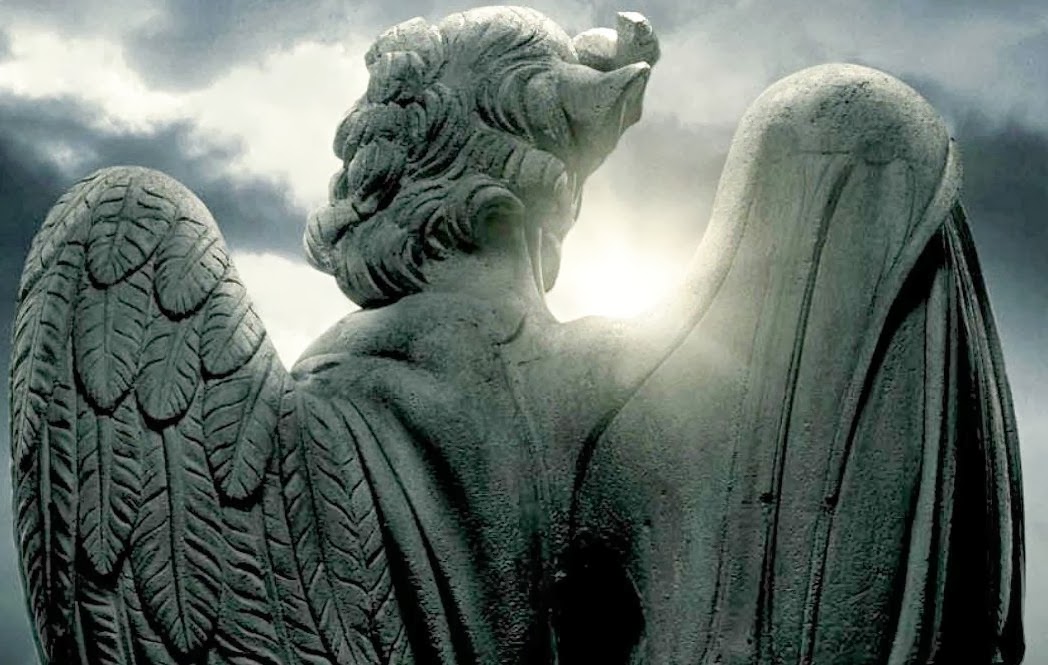
from the Angels and Demons website
Posted as week "A" of the Pagan Blog Project 2014

Originally, stories of angels came from ancient Persia and were adopted (and adapted) into Christianity via Judaism. According to the Talmud, all beings-including animals-are assigned a guardian angel.

Angels are immortal beings who live on the spiritual plane and serve as intermediaries between mankind and the Divine. In Latin the word angelus means "messenger". Hebrew scholars describe them as mal'ak elohim ("messenger of G-d"). Other translations describe them as Elohim elohim,"sons of God". Angels in early art are depicted as 'shining ones', attractive abet androgynous beings ( having neither masculine nor feminine features). The earliest renderings of angels ( in the catacomb of Priscilla, mid 3rd century) showed them in the role of messengers without the familiar halo and wings. The earliest known representation of angels with wings come from the time of Theodosius I ( 379-395).  The revered early Church writer John Chrysostom theorizing on the addition of wings to angels in liturgical art says," They manifest a nature's sublimity. That is why Gabriel is represented with wings. Not that angels have wings, but that you may know that they leave the heights and the most elevated dwelling to approach human nature. Accordingly, the wings attributed to these powers have no other meaning than to indicate the sublimity of their nature."[ The Figure of the Angel in the Early Christian Civilization, Cecilia Proverbio,2007].

A gathering of angels is known as a legion; and interestingly enough, the term is used for a group of demons as well. Just one more link between the two entities in common usage that insinuate the supernatural power ( and fear) they wield. The definition finds it's legitimacy in a vague association with the numbers of soldiers of  a major unit of the Roman army, and is most likely one foisted into the lexicon by the ancient Church to impress upon the populace the importance of both entities. The peoples of the classical nations of antiquity knew what it was like to be over-run by military assaults, and the Church often repurposed terminology to get its point across.

In Judeo-Christian and Islamic mythology the most notable of all angels are the Archangels, each of which were assigned to a specific area of Heaven: Gabriel, Raphael, Michael, Uriel, Jophiel, Zadkiel and Samael (also known as Lucifer, who would later be identified as Satan in the Bible).  In Islam, Israfil and Azrael are included in the group with Michael and Gabriel; Metatron is recognized in Jewish writing, although his existence is not considered canonical.  The actual number of Archangels varies from source to source-as do the names [http://www.beliefnet.com/Inspiration/Angels/2006/07/One-Archangel-Two-Archangels.aspx]. The only entity agreed upon by the major mainstream Christian religions is Michael, because he is specifically references as such in the Bible. [ Angels: God's Secret Agents, Rev.Dr. Billy Graham, W Pub Group, 1994]. In Kabbalistic teaching, specifically speaking of the Tree of Life, both angels and archangels are associated with each of the branches.

Until the mid 18th century, angels as messengers were common in everyday life, and the vision or sighting of one was a portent to a monumental event (note here, demons were also commonly a part of everyday life as well).  Angels were credited with everything from fortuitous luck to the heralding of plagues and curses on the command of G-d. [ Revelations 15:1,16:2-15, New King James Version (NKJV Bible), Thomas Nelson Publishing]. As the Age of Enlightenment slowly took hold and emphasized reason and logic from a non-religious standpoint, the sighting of angels became less and less common, and they were relegated to the realm of myth and folklore.

The belief that angels were once human is not canonical; it was developed by the Christian mystic Emanuel Sweedenborg during his quest to reform the Christian belief system.[http://www.swedenborg.com/emanuel-swedenborg/explore/spiritual-world/] Sweedenborg- who was also a scientist and philosopher -went through a personal  spiritual revelation in which he was divinely inspired to author The Heavenly Doctrine, where he visited with angels, demons and other spiritual entities.

Theosophist and Occultist Rudolf Steiner developed a complex listing of the angelic order as a result of his own visionary experiences. He theorized that angels were just above humans in spiritual consciousness and that angels fulfilled a multitude of of duties as they rose in through the ranks of importance," Each one has a special agenda...."[http://www.skepdic.com/steiner.html] Fellow Theosophist Geoffrey Hodson transcribed information given to him by his angel/guide into a series of books, the most notable being The Brotherhood of Angels and Men [http://www.katinkahesselink.net/other/hodson-Bill-Keidan-angelic.html]. Hodson is considered an expert on the subject of angels in certain occult circles, and his ideas are worth exploring if you are at all interested in Theosophy or  the New Thought Movement.

Modern Christian theology contents that angels have never been members of the human race. This is empirical thought across  the many variations of Christian doctrine as there is no mention of a human making the leap into the ranks of the angels in the Bible, where they are specifically described as a separate class of being who reside in Heaven as honored servants of G-d. The quaint belief that when humans die they transform into angels and 'earn their wings' is strictly romantic literary license.

With the coming of the New Age Movement, angelic visions have enjoyed an uptick. The form the angel takes has branched out from the one of the robed messenger depicted in commercial art and depends on the religious background and spiritual beliefs of the individual, as does the meaning for the visitation. In this scientifically influenced era, the sighting of an angel is commonly a part of the description of any near death experience (NDE) as related by the work of Dr. Raymond Moody [http://www.lifeafterlife.com/].

A renewal of all things angel-related is evidenced by a brief visit to the local gift shop or metaphysical goods store. They are everywhere-in books, on necklaces, key chains, T shirts and invoked in prayer and ceremonial magick. They are guardians, guides and messengers and a visual gateway to all things spiritual.


Tuesday, January 14, 2014

Ungrounded

The first few days of the New Year always feel a little weird to me: jumbled and not quite settled, like the inside of a snowglobe someone has just shaken.

Moving in the middle of last year has done a couple of things. While it did give me my own apartment-the only space that has truly been my own in six years- it has left me feeling uprooted and unable to focus. There are too many little devils in the details- or perhaps the details are the devils. I have managed to celebrate the Sabbats that have passed  (Lughnasadh, Samhain and Yule) on a  superficial level, skimming through quick solitary rituals. Frankly, I feel unfulfilled and slightly queasy. Maybe it's because I'm still adjusting to the vibe of the area ( there is incredible energy here), or because I'm still reeling from making the move from one place to another so quickly- but I am off-kilter and a little giddy, unable to settle down and concentrate on what I'm doing for very long.

With the Cold Moon- traditionally the most powerful moon of the year-only hours away, I feel the need to work on what the Theosophists term the etheric plane to clear this upThe etheric plane is the place we are most ourselves in the realm of magick. After spending so many years finding myself, I refuse to let go of who I have become, which, as I was reminded by my  friend Sandra, who's a Native American shaman..."Who you have become has always been your birthright."

I am considering a very formal ritual for this first full moon of the year. Perhaps it will bring me back to some order and discipline. Although I am basically a hedge witch, sometimes I like the ceremonial approach. ( I don't feel there is any one form of the Craft more more valid than another.) I believe that the Universe responds to whatever it takes, barring anything maleficent or generally harmful. Right now I think I need to focus with more specifically on the crafting angle of my practice since I recently reconstructed the religious aspect. The nature of the Universe it to be constantly changing, and spirituality needs to change,too, to remain relevant. I'm not talking about an about-face, just a few minor shifts in consciousness and practice. Evolution, after all, takes place at its own pace. That's the way of Nature and sometimes I have to remind myself of that little fact when I want immediate results.


Wednesday, January 8, 2014

Opening The Door Of The New Year

Janus on an ancient Roman coin
At the beginning of every year ( and yes, I am late ) I perform a ritual asking the blessing of the Roman God Janus. It is a simple rite which includes a wand, bells, and a smudge stick and shell; it can be done solitary or in a group. When done in a group, I usually have at least one other person assisting.

Janus is the Roman god of endings and beginnings. He is most often depicted with one face looking at the past and one into the future. Some artistic renderings of Janus show him as an old man looking at the past and a youth gazing into the future, reminiscent of the Father Time and Baby New Year figures used in modern New Year Eve graphics (The Romans named the month of January for him).

Janus is associated with the passages of time-beginnings and endings. He is both door-opener and door-closer.
Janus is also the protector of doorways, gates, portals, and boundaries. In ancient Rome, statutes of Janus were found on the gates of most cities (and some buildings) for this purpose. This is why I chose him when I developed this particular ritual for a group of which I was a member.

The Janus Ritual begins with the usual grounding and centering of the participants. ( Light the smudge stick and select those who will assist-if any- before hand. If there are no assistants, then the leader assumes all functions him or herself). The participants gather at the main gate or doorway, and the leader calls upon Janus to join them:

Leader: Behold, we stand at the beginning of a New Year! Janus,open the door! Here we bring our hopes and dreams for the coming seasons... [ The Leader knocks on the door frame with the wand, or the bell is rung at this time. The doorway is censed as a blessing and thanksgiving.]

Participants: Janus, open the door! 
The group processes to the next stop, where the leader repeats the words (or similar) above, adjusting them to the area. In my group ritual, we stopped at the area where we socialized around the fire, the small building we used for meeting in inclement weather (and storage), the pathway to the designated ritual space, and the fence around the property. At home, I begin at the front door, then walk through the kitchen ("...Where friends and hearts meet for food and conversation.."), the living room ("...Where lives and stories are shared...), the bedroom (" ...For whatever dreams may come...") and the bath ("...Where we are physically and spiritually cleansed of the world..."). You may choose other places and words that suit your personal needs and situation.

I find that this simple ritual is a good way to kick off the New Year for me.
[Additional historical information can be found at: http://en.wikipedia.org/wiki/Janus]